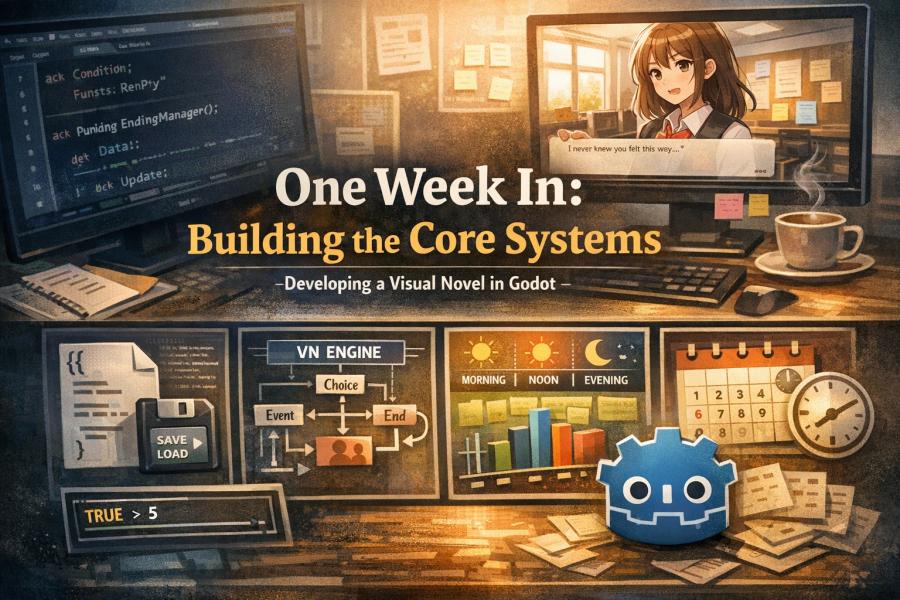
One Week In: Building the Core Systems
26/1/2026
It’s been a week since I decided which engine to use for my new game, and I want to share what I’ve been working on during that time. Long story, short: I spent the entire week building systems.
As I mentioned in a previous article, this game is a visual novel. If I had gone with a niche engine like Ren’Py, I could’ve jumped straight into writing content in the first week. But since I chose Godot, I had to build most of the underlying systems myself.
Some friends suggested using plugins like Dialogic 2 to handle the VN side of things. I seriously considered it, but in the end I decided against it. I didn’t want to risk conflicts with other systems I planned to implement, so I chose to build the core engine from scratch.
Luckily, Godot has autoloads, which are perfect for global variables, state management, and shared functionality. By leveraging autoloads, I was able to design the core as a reusable API. If I ever build a similar game in the future, I can reuse most of this code—or even evolve it into a standalone plugin, similar in spirit to Dialogic.
As of writing this, the Core Engine is basically done. Below are the main systems included in the core, followed by a brief explanation of each.
Core Systems Overview
1. Condition — Condition Evaluation System
Purpose:
Evaluates conditions for events, endings, and VN nodes.
Key Features:
- Supports
stats.*(numeric stats) with comparison operators - Supports
flags.*(boolean flags) - Operators:
>,<,>=,<=,!=, and exact value checks
2. Data — Data Management & Caching
Purpose:
Loads and caches JSON files.
Key Features:
- Dictionary-based cache to avoid repeated loading
- JSON loading with validation
- Used by all other systems as the main data source
3. EndingManager — Ending Management
Purpose:
Evaluates and applies story endings based on conditions.
Key Features:
- Checks all endings defined in
endings.json - Applies the first ending whose conditions are met
- Fallback to a default ending
- Supports two ending types: VN-based or static text
4. Events — Scheduled Event System
Purpose:
Checks and triggers events based on context.
Key Features:
- Events sorted by priority
- Supports
onceevents (trigger only once) - Uses the Condition system
- Effects can modify flags and stats
- Can trigger VN scenes or apply effects directly
5. Flags — Global Boolean State System
Purpose:
Stores global boolean states.
Key Features:
- Dictionary-based flag storage
flag_changedsignal for reactivity- Serialization/deserialization for save/load
- Example flags:
event_[id],ending_[id]
6. Game — Main Game State Machine
Purpose:
Controls the main game flow and state transitions.
Key Features:
- Four states:
SCHEDULE,VN,EVENT,EVALUATION - New game initialization
- Schedule action processing
- Automatic state transitions
- Ending evaluation trigger
7. SaveManager — Save & Load System
Purpose:
Handles saving and loading game progress.
Key Features:
- Saves to
user://save.json - Stores Time, Stats, Flags, and Game State
- JSON-based serialization
8. Stats — Character Statistics System
Purpose:
Manages numeric character stats.
Key Features:
- Dictionary-based values
stat_changedsignal for reactivity- Apply effects (increase/decrease stats)
- Load default values from JSON
- Serialization for save/load
9. Time (GlobalTime) — Game Time System
Purpose:
Manages in-game time progression.
Key Features:
- Day and phase system (morning, noon, evening, night)
- Four phases per day
- Signals for day/phase changes
- Serialization for save/load
10. VN — Visual Novel Engine
Purpose:
Runs visual novel scenes.
Key Features:
- Graph-based VN nodes
- Condition support per node
- Auto-advance for nodes without choices
- Effect application
- Loop detection using
MAX_AUTO_STEPS
Closing Thoughts
Overall, this system feels solid for a VN / life-sim hybrid with scheduling mechanics, stat management, and branching narratives driven by conditions. There’s still room for improvement and expansion, but even at this stage, I can already build a proper vertical slice—UI or not.
And honestly, that’s a good place to be after just one week.